
How Muscle Actually Grows, And How To Train For It

A no-nonsense, evidence-based guide to building muscle without the noise
Written by Andrew Caine, BSc Sport and Exercise Science, MSc Strength and Conditioning
Everyone has an opinion on building muscle. Your mate down the gym, the bloke on TikTok, the influencer flogging a twelve week programme. Most of it is noise, and most of it is exactly why you feel like you train hard and get nowhere.
So let me cut through it. This is the full picture, backed by the research and explained in plain English. How muscle actually grows. How hard you need to train to make it happen.
Which rep ranges build it. How much you can realistically expect to gain and how fast. How to eat to hold onto it. And how to structure the whole lot so all that effort finally turns into something. Stick the kettle on.

Part 1: The three things that drive muscle growth
Back in 2010, a researcher called Brad Schoenfeld published a review that became a cornerstone of how we understand muscle growth. He laid out three mechanisms that trigger a muscle to get bigger: mechanical tension, metabolic stress and muscle damage.
Mechanical tension is the big one. It is the force your muscles produce when they contract against a challenging load through a full range of motion. Lift something heavy enough, control it properly, and you create the tension that tells the muscle it needs to adapt and grow. Since that 2010 paper the research has moved on, and the current consensus is clear: mechanical tension is the primary driver of muscle growth. Everything else is secondary.
Metabolic stress is the burn and the pump you feel on higher rep sets with shorter rest. That build up of metabolites plays a supporting role in growth, but it is not the main event. Chasing the pump for its own sake will not build you a physique.
Muscle damage is the one most people get wrong. For years the thinking was that battering a muscle and being sore for three days meant you had grown. Work by Felipe Damas and colleagues in 2016 pushed back hard on that. Their research showed muscle damage is not the thing driving growth. It is more of a byproduct of training, and severe soreness mostly just tells you that you did something your body was not used to.
The takeaway: stop using soreness as a scorecard. You do not need to destroy a muscle to grow it. You need to load it with challenging weight, take it through a full range of motion, and add a little more over time. Tension is king. Progressive overload is how you keep applying it.
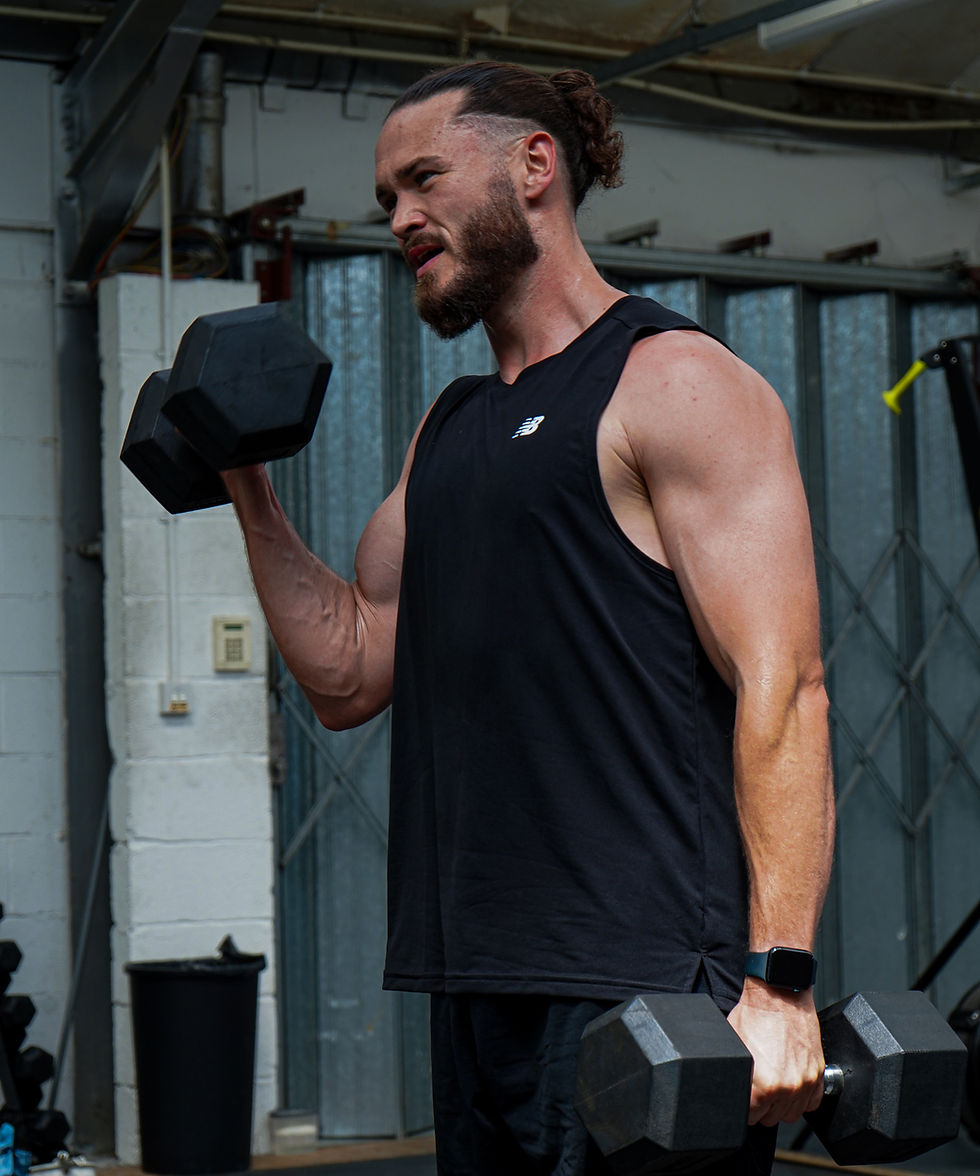
Part 2: How hard should you actually train?
This is where most people either do far too little or run themselves into the ground. You have heard both extremes. If you are not looking like you are about to pass out, you are not trying hard enough. Or on the flip side, cruising through your sets barely raising your heart rate and wondering why nothing changes.
The truth sits in the middle, and there is a simple way to measure it: reps in reserve, or RIR. It means how many reps you had left in the tank when you ended the set. Finish a set with two reps in reserve and you could have done two more before your form broke down.
A 2023 meta-analysis led by Martin Refalo pulled together the research on how close to failure you need to train. The short version: training close to failure is what drives growth, but you do not need to grind every single set to the point where the bar stops moving. There is a small benefit to pushing closer to failure, but training to complete failure on everything wrecks your recovery and leaves you too beaten up to train hard again soon.
Here is how to apply it:
For building muscle: leave 1 to 3 reps in reserve on most working sets. Hard, but controlled.
For building strength: leave 3 to 5 reps in reserve so you can keep your technique sharp under heavy load.
Push to true failure occasionally, maybe on the last set of an exercise, to test yourself. Just do not live there.
Get this right and you create enough stimulus to grow without burying yourself. That is the balance that lets you keep turning up and progressing week after week.

Part 3: What rep range actually builds muscle?
Ask ten people the best rep range for muscle and you will get ten answers. The textbook version goes like this:
1 to 5 reps for strength
6 to 12 reps for muscle growth
15 plus reps for endurance
It is a decent rule of thumb, but it is nowhere near as rigid as people make out. A 2017 meta-analysis by Schoenfeld, Grgic and colleagues compared lighter loads against heavier loads for muscle and strength. The finding that matters: muscle growth was similar across a wide spread of rep ranges, as long as sets were taken close to failure. Strength, on the other hand, clearly favoured heavier loads.
In plain terms, you can build muscle anywhere from around five reps up to twenty plus, provided the effort is there. What counts is how hard the set is, not hitting some magic number.
This matters more than it sounds. If you train at home with light dumbbells, or you are at a rammed gym and the weight you wanted is taken, you are not wasting your time. Go higher on the reps, push the set close to failure, and you will still grow. The one caveat: if pure strength is your goal, you still need to spend time lifting heavy in those lower rep ranges.
Part 4: How much muscle can you realistically build, and how fast?
Social media has completely warped what normal progress looks like. If you are not shredded with a full set of abs by next month, you feel like you are failing. You are not. You have just been sold a fantasy by people selling something.
Two of the most widely used models for realistic muscle gain come from coaches Lyle McDonald and Alan Aragon. They are practitioner models rather than lab studies, but they line up well with what actually happens in the real world, and they give you a sensible frame.
For a man training properly in his first year, under good conditions, you might gain somewhere in the region of 9 to 11 kilograms of actual muscle. That is roughly one and a half to two stone. Women can expect around half that, largely down to hormonal differences, and it is no reflection of effort.
Two things to be honest about. First, that is muscle, not scale weight, and it is the upper end. Most people land lower, somewhere around 3 to 6 kilograms in year one, because life gets in the way of perfect training and nutrition. Second, it slows down every year after. Year two might be half of year one. Year three, less again. The longer you train, the harder each kilogram is won.
The point of all this is not to depress you. It is to set you free from the nonsense. Building a body you are proud of is a long game measured in months and years, not a thirty day transformation. Once you accept that, you stop quitting every time the quick fix does not deliver, and you actually start making progress that lasts.

Part 5: How to hold onto muscle: protein
You can train perfectly and still leave results on the table if your nutrition is off, and the single biggest lever for building and holding muscle is protein.
The most cited work here is a 2018 meta-analysis by Robert Morton and colleagues, which pooled 49 studies and nearly 1,900 people. The benefit of protein for building muscle climbed up to around 1.6 grams per kilogram of body weight per day, then levelled off. Beyond that, more protein did not add more muscle.
So a practical target for building and keeping muscle is roughly 1.6 to 2.2 grams of protein per kilogram of body weight per day, spread across your meals rather than crammed into one. For an 80 kilogram person that is somewhere around 130 to 175 grams a day.
This matters even more if you are dieting to lose fat, or if you are adding cardio or running on top of your lifting. When you are in a calorie deficit or burning more through extra training, protein is what protects the muscle you have worked to build. Skimp on it and that is often where size quietly disappears.
Part 6: Putting it together: focus beats chaos
By now you know how muscle grows, how hard to train, which rep ranges work, what is realistic, and how to eat to hold onto it. The final piece is the one almost everyone gets wrong: structure.
Most people want it all at once. Stronger, leaner, fitter, more muscle, better mobility. So they chase every goal at the same time, spread themselves thin, recover from nothing, and a few weeks in they are sore, flat and wondering why their body looks exactly the same.
The fix is periodisation. A 2017 meta-analysis by Tyler Williams and colleagues found that structured, periodised training produced greater strength gains than just doing the same thing all the time. Periodisation simply means organising your training into planned phases, each with a clear focus, rather than winging it.
In practice it looks like this. You break your training year into blocks. Coaches call a single block a mesocycle, and the full year made up of those blocks a macrocycle. Fancy words for a simple idea: do one thing at a time, in order, on purpose.
Say fat loss is the priority. You spend around eight weeks in a small calorie deficit with dropping body fat as the goal. You still lift three times a week, but you manage the load and volume to hold onto muscle rather than chasing new personal bests on low fuel. Then that block ends and you switch. The next eight weeks might be about building muscle, so you bring calories up to maintenance, eat enough to grow, and make progressive overload in the gym the priority.
Everything else gets maintained, not maxed. You are not neglecting the other goals, you are just not fighting yourself on five fronts at once.
This is exactly how I train myself. Right now my priority is the Loch Ness marathon, so running leads and my strength work is being maintained rather than pushed. I am not trying to hit marathon personal bests and squat personal bests in the same eight weeks, because I would do neither well. Once the race is done, the focus shifts back to strength. One block at a time.
The bottom line
None of this is complicated, but it is easy to get wrong when you are drowning in conflicting advice. So here it is stripped back:
Muscle grows mainly from mechanical tension. Lift challenging loads through a full range and add a little more over time.
Train close to failure, leaving 1 to 3 reps in reserve on most sets. You do not need to destroy yourself.
You can build muscle across a wide range of reps, as long as the effort is high.
Progress is a long game. Be patient and ignore the thirty day nonsense.
Hit your protein, around 1.6 to 2.2 grams per kilogram of body weight a day.
Focus on one goal at a time in blocks, and you will get further than chasing everything at once.
Understanding all of this is one thing. Applying it consistently, around your job, your family and your life, is where most people come unstuck. That is exactly what I do as a coach. If you want your training, nutrition and structure built around you and your goals so you can stop guessing and start progressing, drop me a message with the word START, or head to my website and fill out the application form.
Andy.
References
Schoenfeld, B. J. (2010). The mechanisms of muscle hypertrophy and their application to resistance training. Journal of Strength and Conditioning Research, 24(10), 2857-2872.
Damas, F., Phillips, S. M., Libardi, C. A., Vechin, F. C., Lixandrao, M. E., Jannig, P. R., et al. (2016). Resistance training-induced changes in integrated myofibrillar protein synthesis are related to hypertrophy only after attenuation of muscle damage. The Journal of Physiology, 594(18), 5209-5222.
Refalo, M. C., Helms, E. R., Trexler, E. T., Hamilton, D. L., & Fyfe, J. J. (2023). Influence of resistance training proximity-to-failure on skeletal muscle hypertrophy: a systematic review with meta-analysis. Sports Medicine, 53(3), 649-665.
Schoenfeld, B. J., Grgic, J., Ogborn, D., & Krieger, J. W. (2017). Strength and hypertrophy adaptations between low- vs. high-load resistance training: a systematic review and meta-analysis. Journal of Strength and Conditioning Research, 31(12), 3508-3523.
Morton, R. W., Murphy, K. T., McKellar, S. R., Schoenfeld, B. J., Henselmans, M., Helms, E., et al. (2018). A systematic review, meta-analysis and meta-regression of the effect of protein supplementation on resistance training-induced gains in muscle mass and strength in healthy adults. British Journal of Sports Medicine, 52(6), 376-384.
Williams, T. D., Tolusso, D. V., Fedewa, M. V., & Esco, M. R. (2017). Comparison of periodized and non-periodized resistance training on maximal strength: a meta-analysis. Sports Medicine, 47(10), 2083-2100.
Muscle gain rate estimates are drawn from the widely used practitioner models of Lyle McDonald and Alan Aragon.


Comments