
Lifting Through a Marathon Block: How I Hold My Strength Without Wrecking My Running

The gym half of my Loch Ness build. What I keep, what I cut, why I stopped training for the camera, and the science behind why a runner should be lifting at all.
Training like a petulant child who has just discovered the gym is a sure way to fuck yourself up and destroy your running prep.
Now, I was not doing anything terrible before. I trained fairly smartly, picked the right exercises, did not overload myself into the ground. But if I am honest, I had got hooked on how it all looked from the outside. How heavy I was lifting. Whether the exercises were cool enough to film. Whether some stranger scrolling past would be impressed. Even the running crept into it. Were my Strava splits fast enough to look good to someone I will never meet.
Yep. Even those of us who should know better fall into the Instagram trap from time to time.
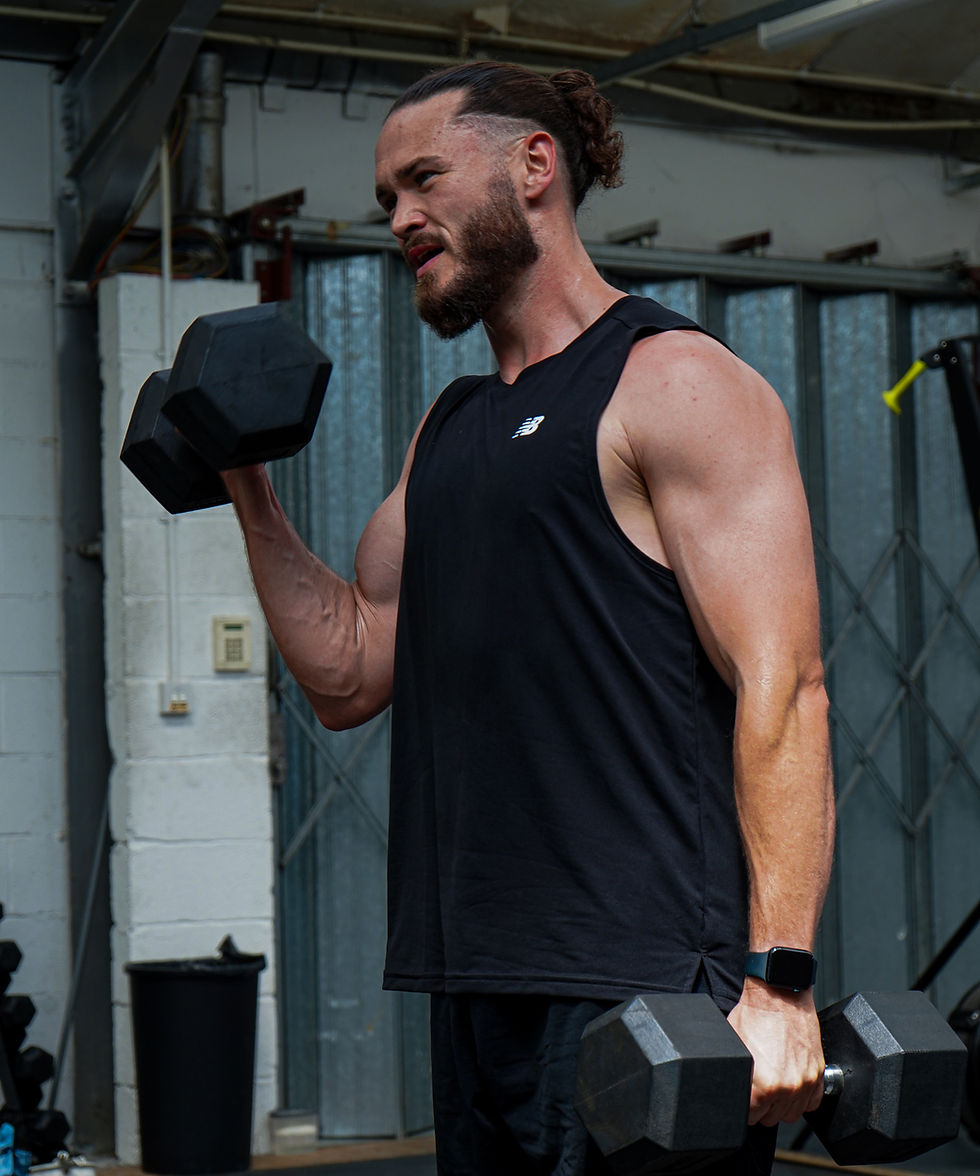
So the process this time round is simple. Stop giving a fuck how it looks, and do what I actually know I need to do to put myself in the best possible position for one race. I am seven weeks out from the Loch Ness Marathon, and the gym now has one honest job. Keep the strength and muscle I have built without touching my running or my recovery.
That is the tightrope every runner who lifts has to walk. Do too much under the bar and it batters your legs and eats the recovery your mileage needs. Do nothing and you slowly come apart because you are weak. Sport science calls the tension between the two concurrent training. The good news is the research is dead clear on how to get it right, and most people miss in one direction or the other.
You keep strength on far less than you think
Here is the finding that should change how you lift in a hard running block. Holding onto the strength and muscle you already have takes a fraction of the work it took to build them.
Bickel and colleagues (2011) showed trained lifters kept their strength for a full 32 weeks on roughly a third of their original training volume. Reviews of the minimal dose research go further, concluding that as little as one hard set per exercise, as little as once a week, can hold strength for months. There is one non negotiable condition attached to all of it. The weight has to stay heavy.
That is the whole game. Intensity, the actual load on the bar, is the thing you protect. Volume, the number of sets, is the lever you pull down. In a marathon block you do not need to bin the weights, and you do not need to live in the gym. Heavy and brief. That is it.
That is exactly how my week looks. Three times a week, whole body sessions, ninety minutes maximum, and the big lifts, squat, deadlift, bench and press, stay heavy at low reps. I am not chasing personal bests and I do not care how the numbers look on a story. Sunday I ran 20k, Monday I had a heavy bar on my back, and both of those being possible in the same day is the entire point of programming it this way.
Strength and muscle are two different jobs

One nuance worth getting, because it decides what you cut and what you keep. Holding strength and holding muscle are not the same task.
Strength is mostly a nervous system skill, and you protect it by lifting heavy. Muscle size leans more on volume and on food. So while I strip the sets right back on the big compound lifts to look after my legs and my recovery, I keep the accessory work, the curls, the rows, the single leg stuff, closer to normal, so I hold the muscle without frying my nervous system. And I eat for it. Enough protein, enough calories, because you cannot keep muscle in a deep deficit no matter how clever your programming is.
Why a runner should be under a barbell at all
If the goal is a marathon time, why spend three hours a week lifting instead of just running more? Two reasons, both backed by a stack of research.
The first is that lifting makes you a more efficient runner. Heavy strength work improves running economy, which is just how much energy you burn to hold a given pace. Meta analyses of trained distance runners put the improvement somewhere around 2 to 5 percent, and it shows up in real performance, faster time trials and longer time to exhaustion. The telling part is that it does this without touching your VO2 max and without adding bodyweight. It is not a bigger engine, it is the same one burning cleaner, through a stronger, stiffer, more efficient stride. Better still, newer research shows strength trained runners hold that efficiency deeper into fatigue, when everyone else's form is falling to bits. In a marathon that is the back end of the race. My last two marathons, the final 10k is exactly where it has fallen apart for me, and I know my legs are a big part of that.
The second reason is that strength training is the best injury insurance we have, full stop. A landmark 2014 meta analysis by Lauersen found strength training cut overuse injuries, the bracket nearly every running injury falls into, by roughly half. His follow up in 2018 put the drop in overall injury risk at around two thirds, and it was dose dependent, so more strength work bought more protection. For someone who tends to be injury prone, that is not a nice extra. That is the thing that keeps me on the start line.

The quads, and why Loch Ness in particular demands them
Here is where it gets specific, because the race you are training for should shape the strength work you do, and Loch Ness makes a very particular set of demands on one muscle group.
Before dawn I will be bussed out to a remote stretch of moorland between Fort Augustus and Foyers, pipe band playing us off if the stories are right. And then the course sets about battering my quads at both ends of it.
The first 6 to 7 miles drop hard down a military road. It feels fast and free, like gravity is handing you a gift, and it is a trap. Bombing a steep descent is one of the most punishing things you can do to your legs. Downhill running is heavily eccentric, meaning your quads are lengthening under load on every single stride to brake you, and that is the exact contraction that tears muscle fibres and leaves you wrecked. Trash your quads in the first hour and the rest of that race is going to be very, very long.
And later is where the second demand lands. A long grinding climb arrives at around mile 17 to 19, right as the fatigue is well and truly setting in, before the flat run into Inverness and the crowds at Bught Park.
So the course asks my quads to survive a savage downhill early and then drive a climb late, on tired legs. Building eccentric strength and resilience in them now, months out, is the best advantage I can give myself. Squats, walking lunges, and single leg work like the contralateral RDLs teach the legs to absorb and produce force under load. Same protective adaptation, trained in advance and under control, so that on the day the downhill does far less damage and the climb still has something to pull on. The soreness in my legs this week is that adaptation starting. Uncomfortable now, armour later.
All part of the fun, hey.
The point of it all
None of this is about lifting big numbers right now, and it is definitely not about how any of it looks on a screen. It is maintenance, in service of the run. Heavy enough to keep what I have built, brief enough that it never steals a session from my running, targeted enough that it arms my legs for the specific race in front of me.
Every set has a reason now. I am lifting to run better, to stay in one piece, and to still be strong when I cross the line in Inverness rather than in spite of it.
More to come as the block builds.
Stay blessed.
Andy.
Key reading, if you want to go down the rabbit hole yourself: Bickel et al. (2011), Medicine and Science in Sports and Exercise, on maintaining strength with reduced volume. Lauersen et al. (2014) and (2018), British Journal of Sports Medicine, on strength training and injury reduction. Blagrove et al. (2018), Sports Medicine, on strength training and the determinants of distance running performance.


Comments